


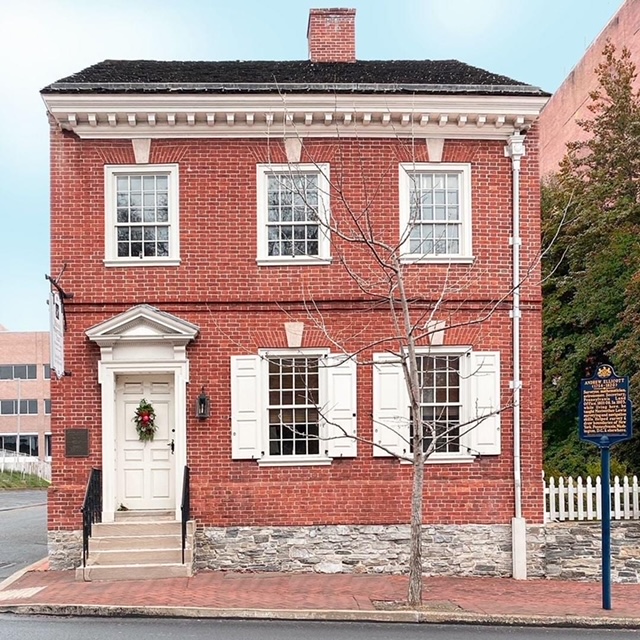
Hands-On History: The Science of Traditional Trades
Registration Deadline: May 9, 2026
- Part of the Remake Learning Days
- Date: 5/16/2026
- From: 10AM-1PM (drop-in event)
- Cost: Free
“Hands-On History: The Science of Traditional Trades” is an interactive, station-based program designed to connect school-aged students with the STEM principles embedded in historic building trades. Through tactile demonstrations and guided experimentation, students discover that carpenters, masons, blacksmiths, roofers, and craftspeople are not only skilled artisans—but applied scientists and engineers. Each station invites students to explore how math, physics, chemistry, and environmental science shaped the buildings that still stand in communities like ours today.
At the Carpentry + Structural Engineering station, students experiment with load paths, compression, and tension using small-scale wooden frames. Concepts like gravity loads, triangulation, and span limits become tangible as students test which designs hold the most weight.
The Masonry + Material Science station introduces brick, stone, lime mortar, and concrete. Students examine the properties of natural versus manufactured materials, exploring porosity, strength, and flexibility. A hands-on creation of a mini “brick wall” with different mortar types. Discussions connect permeability and thermal mass to energy efficiency and durability.
At the Blacksmithing + Heat Science station, students learn how heat changes metal. Through demonstrations, they explore how temperature affects malleability and strength cold vs warm bending of metal.
The Roofing + Weather Science station examines how buildings defend against the elements. Students test miniature roof models with varying pitches and materials under simulated “rainfall” to observe water runoff and drainage.
At the Wood Science + Joinery station, students study wood grain, moisture movement, and species differences. They compare hardwoods and softwoods, test flexibility, and assemble simple joinery like mortise-and-tenon connections. Concepts such as expansion and contraction, cellular structure, and anisotropy highlight why traditional joinery accommodates seasonal movement without failure.
The Simple Machines + Millwork station focuses on mechanical advantage. Using pulleys, levers, inclined planes, and block-and-tackle systems, students discover how heavy timbers and stones were lifted before modern equipment. Hands-on models demonstrate how gears and cams powered historic mills, linking physics principles to local industrial heritage.
In the Finishes, Paint + Chemistry station, students explore the composition of traditional paints and finishes. Through safe, age-appropriate experiments, they learn about binders, pigments, and solvents.
Finally, the Surveying + Measurement station emphasizes math and precision. Students practice using measuring tapes, levels, and plumb bobs. Activities introduce geometry, angles, and ratios while reinforcing why accuracy matters in construction. Mapping exercises show how early builders laid out towns and properties with remarkable precision.
By rotating through these stations, students experience history not as something static, but as a living laboratory of STEM innovation. Traditional trades become a gateway to understanding engineering, environmental science, chemistry, and physics—proving that the science behind historic buildings is as relevant today as ever.
- May 16 2026
- Expired!
- 10:00 am - 1:00 pm
- 123 N. Prince Street, Lancaster PA 17601